|
|
 |
|
|
|
Pest Control Services
|
|
|
|
|
|
|
Treatment of Rats
|
|
|
Brown Rat - Also known as the Norway Rat, Common Rat or Sewer Rat. It is a worldwide pest of industrial, commercial and domestic premises. |
|
It can be a major pest on some farms, where warmth, food and a source of water are easily found. Like the House Mouse, this animal is nocturnal, but the Brown Rat is very wary of new objects and is said to be neophobic (fear new things). A single Brown rat may produce up to 40 droppings in 24 hours so the contamination potential of these animals is high.
Brown rats are capable of carrying several diseases, amongst which, in the UK, are Salmonella food poisoning and Weils disease (Ieptospiral jaundice).
|
Treatment of Mice
|
|
|
The House Mouse is a worldwide pest of buildings. They are nocturnal creatures and are extremely inquisitive, exploring their surroundings mainly by
touch as their eyesight is not particularly good. |
|
A mouse can produce up to 80 droppings in 24 hours, so food and food preparation surfaces can easily become contaminated even when only a small number of mice are present. Probably the most important disease that can be transmitted by mice in the UK is Salmonella food poisoning.
|
Treatment of Wasps
|
|
|
There are six species of wasp commonly found in the UK but only two enter buildings. Wasps can be seen throughout the country but the wasp 'season' tends to be shorter in the cooler north. |
|
Wasps build elaborate nests made from a papery substance. Nests can be located hanging from trees, bushes and hedges, or beneath roof tiles, in attics, garages, etc. A wasp nest survives only for that season as the nest dies off in the late autumn, and although they will never re-inhabit an old nest, they may build a new one directly beside an old nest. At the height of the season, there may be as many as 25,000 wasps in a very large nest!
|
Treatment of Ants
|
|
|
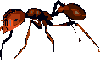
The Black garden ant is to be found throughout the UK, particularly where soil is of a sandy nature. It is common around homes and the workplace, the worker ants
|
|
entering through cracks in brickwork and around windows in search of food. These ants follow trails, so when a rich source of food is found, this information is communicated back to the nest resulting in large numbers of ants following a trail from the nest back to the food source. Nest openings can be distinguished by small piles of fine earth.
|
Treatment of Fleas
|
|
|
Adult fleas are normally 1-8mm long, brownish in colour, no wings but muscular legs adapted for jumping. The potential life span of a female flea is two years during which she can lay up to 1000 eggs. |
|
The cat flea (Ctenocephalides felis) causes most flea infestations. The significance of this is explained by the increased number of pets being kept and the tendency for their beds to be neglected during cleaning. Wall to wall carpeting also provides a relatively undisturbed environment for flew larvae to develop. Fleas are objectionable because of the bites they inflict and because of the social stigma attached to humans with flea infestations. Flea bites are identified as a tiny dark red spot surrounded by a reddened area. The intensely irritating bite persists for one or two days.
|
Treatment of Cockroaches
|
|
|
The Common, or Oriental cockroach, is well-established throughout the UK. These insects prefer cooler environments to the German cockroach and tend to be found deep within building fabric. |
|
This makes infestations of the Common cockroach difficult to control, as getting insecticide to the harborages can be difficult, if not impossible. These pests can be found almost anywhere, from kitchens to cellars, in wall cavities, around fire places, in rubbish dumps and virtually any work environment. These insects are often confused with ground beetles.
|
|
|
|